Way of Water
The Way of Water focuses on developing Devotion, Unconditional Love and Surrender. Way of Water has two main modes of practice that can be combined or performed separately: Tantrik Ritual with Deity Yoga and Kriyā Yoga.
These two techniques of the Way of Water are supported by the practitioner's cultivation of a rich inner environment and lived experience of virtuous conduct, compassion cultivation, and guru yoga.
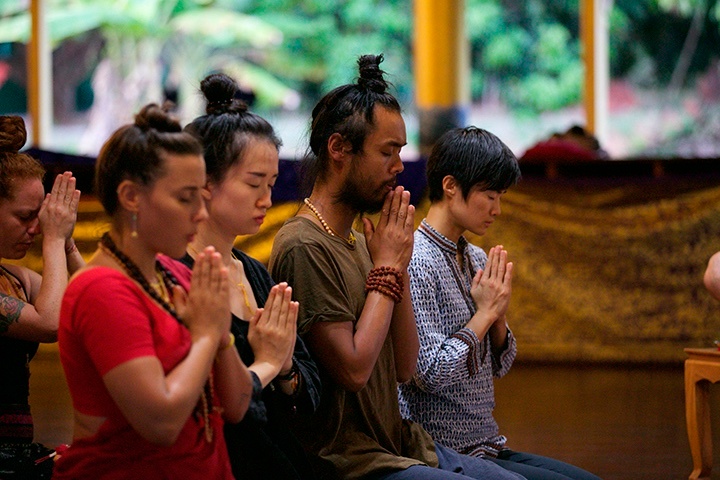
Multi-Faceted Approach
Way of Water practice combines the components described below into one cohesive path of practice — Tantrik Ritual, Kriya Yoga, and Guru Yoga, embedded within a matrix of Virtuous Conduct, Devotion, Compassion and cultivation of the Enlightened Bhava of the Deity.
The Main Virtues, Mode of Being & Attainment Cultivated in Way of Water
A Way of Water practitioner is someone who is attracted to developing and expressing the virtues of Love, Devotion, Compassion, Surrender, Humility, Acceptance and Non-Resistance as their main focus. They are Heart-Centered people who wish to practice a path of Beauty. Love is its own type of Spiritual-Fire. It quickens realization of the Path and avoids the dangers of over-strenuous effort and pompous spiritual pride.
In summation, the Way of Water is the Way of Love & Devotion. Life is lived as a Compassionate Intent, and this is its own reward.
The Main Components of the Way of Water:
Learning and performing Puja (water based ritual) and Homa or Yajña (fire based ritual) for your deity, and for performing compassionate actions.
Outer, Inner and Secret modes of unification with your Deity's Essence, thus awakening you to your own enlightened condition.
Working in the subtle energy system of nadis, cakras, and bindus in order to transform all karmic conditioning and limitation of body, speech and mind.
Learning to rest in the bhava of Devotion, Compassion & Surrender, transforming all actions into virtuous conduct beneficial to all.
Realizing one's Nature in the Polished Mirror of the Guru's Essence. Outer, Inner, and Secret modes of unification with one's own Nature.
The Way of Water has two mutually complementary tracks:
- Track I — Tantrik Ritual & Deity Yoga
- Track II — Kriyā Yoga

Tantrik Ritual — Pūjā

What is Pūjā?
In Level One of the Way of Water, you will learn the ancient Tantrik practice of Pūjā. Pūjā is the Sanskrit word for ritual or ceremony. However, Trika Mahāsiddha Yoga does not have in its View Teachings any "Supreme God or divinity" who is the Creator, or who is superior to our own Essence, that we bow down to, or upon whom we are dependent for our liberation.
How does it work?
In the performance of esotericized Tantrik Pūjā, the practitioner brings forth the deity from their own continuum of consciousness-energy and into our world of form and desire, thus manifesting their power and wisdom in the various receptacle components of the ritual. This gives the practitioner a focal point upon which to concentrate in order to more effectively contact and engage with the formless subtle body of the deity.
Pūjā is a Form of Dynamic Meditation.
Tantrik Pūjā is also a very efficient, beautiful and enjoyable way to attain fusion of the three centers of body, speech and mind, allowing the discursive mind and emotions to stop, so that we can relax into our True Nature.
Beginner Pūjā
At the end of Beginner Pūjā training the student will be able to masterfully perform the 16 offering pūjā of a deity, an Ātmā Pūjā and chant the liturgy and prayers involved in most Tantrik Pūjās.
- Review of 16 Upacaras (standard offerings) — Learning how to set up a proper basic 16 offering ritual with proper offering techniques, mantras, etc.
- Preliminaries — Ceremonies have certain preliminaries which must be observed before the main body of the ritual proceeds.
- Purification Ceremony — Purification of the space, the ritual instruments, offerings, the person performing the ritual, etc.
- Dhyana Ślokas — Learning to invoke the deities and gurus through their descriptive contemplation verses (Śiva, Bhairava, Mahākala, Śambhunātha, Bhairavi, Ganeśa, Durga, Sarasvati, Hanuman, Kali, Lakshmi, Camunda…)
- Pūjā practice — Putting items 1–4 all together to practice the art of basic pūjā.
- Atma Pūjā — Tantrik ritual of invoking the apparent individual self-form as a pure and perfect emanation of the One Essence.
- Universal Prayers — A collection of prayers used regularly in the rituals, such as peace prayers, etc.
- Stotras & Suktam — A category of longer prayers chanted in the rituals.
Intermediate Pūjā
- Abhishekhams & Practice — Practicing the ritual empowerment of a deity. Crucial to Deity Yoga, Tantrik Ritual and the Way of Water.
- Agni-Hotra — The daily practice for yogins to attune themselves to the cosmic cycles and open their spiritual Heart-Center.
- General Homa — The structure and procedure of a standard fire ceremony.
- Navagraha Homa — Fire sacrifices to the 9 Planets to raise awareness of limiting karmic patterns.
- Vastu Homa — An important ceremony for consecration of any building, especially your home and practice place.
- Ayushya Homa — A ceremonial fire sacrifice that confers longevity through balancing the doshas' root causes as Tejas, Ojas and Prānā.
- Gaya Śraddha — Offerings made for all beings who died from tragedy. Performed every Fall season.
Advanced Pūjā
- Dharma Partner Ritual — Formalizing a "life-long" commitment to each other's realization "no matter what", modeled after the Dharma Partnership ceremony enacted by Śrī Rama with Hanuman.
- Funeral for a Yogin — Performing this Yogin's Funeral is a tremendous aid to the yogin in the after-death states, giving strength, guidance, and confidence to transition without faltering.
- Exorcism Rituals — Ritual Exorcism understood as a form of spiritual hygiene. Highly effective in re-establishing an unobstructed experience in the practitioner's life.
- Narayana Bali — Used to rectify prānā disturbances in our life, mind and body caused by astrological birth chart configurations.
- Elaborate Rahu Appeasement Ritual — A powerful way to raise awareness of hidden karmic patterns and release or transform them.
Deity Yoga & The Daśamahāvidyās
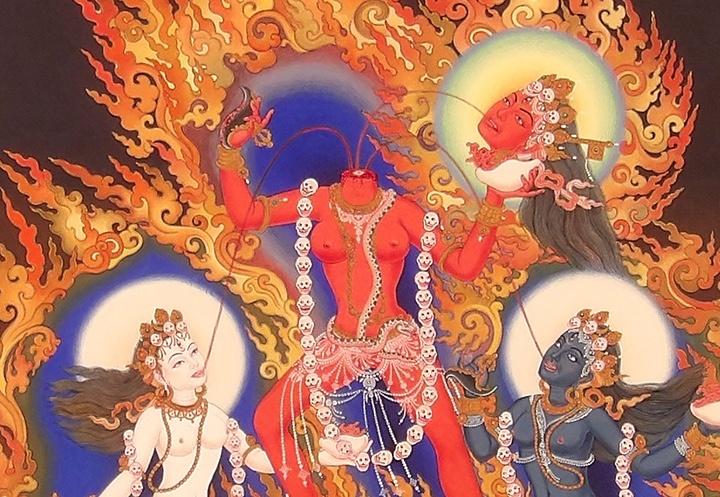
Deity Yoga shifts attention to the entry points of mind and energy as expressed in the practices of Kriya Yoga, Deity Yoga (specifically the Daśamahāvidyās or Ten Wisdom Dakinīs), and the Heart of Devotion.
Devotion is an essential component of human realization and the path of practice itself. Cultivating the Heart of Devotion quickens all spiritual processes through accelerating the bhava of "surrender", wherein we release the attachment to our "self-story." Through the practice of Deity Yoga we discover our capacity as the inner energy of the channels, cakras, bindus, lights, sounds and rays.
The Daśamahāvidyā Retreat
Entering the Sacred Mandala of Blessings from the 10 Wisdom Dakinīs
The Daśamahāvidyas are a collection of Ten Wisdom Goddesses or Dakinīs of the more recent Indian Tantrik tradition — a grouping of powerful female transformational energies of awakened consciousness. Each dakinī is a fully enlightened deity able to guide the practitioner beyond the mire of their karmic mind, energy and body into the sublime experience of liberation while living.
All ten are different enlightened "flavors" of the One Essence Nature. During retreat, Dharma Bodhi and Sahajadakinī will perform an ancient ceremony during which we will enter the Pure and Sacred Mandala of the Ten Wisdom Dakinīs — and the student will be chosen by the appropriate dakinī through a special oracular procedure.
*Note: For those who have completed Beginner Tantrik Puja, you may opt to bring your travel pūjā kit with you to begin performing personal puja with your newly acquired dakinī immediately after the dakinī chooses you.


Kriyā Yoga

Swami Rudrānanda
Rudi's Kriya Yoga: Esoteric Science of Mastering our Subtle Energies
Kriya Yoga puts you into direct engagement with your subtle body's channels, cakras, bindus, winds, elements, etc. In the practice of Tantrik Yoga nowadays it is more common to learn deity yoga practices without being taught the practices of kriya yoga that are part of the total deity yoga method. The kriya yoga component is like the engine that drives the empowerment of the visualizations and mantras of the deity and manifests their experience in your time/space continuum.
Kriya Yoga is also practiced as a stand-alone spiritual technology of liberation. In this mode, the Rudrānanda Kriya Yoga System is an excellent core practice of inner alchemy able to transform all limiting karmas when combined with Pure Motive and the Heart of Devotion to Path and Teacher.


Completion-Phase Practice Retreats

Śri Vidyā — Puja, Teachings, Mantra Transmission & Direct Realization Teachings and Practices.
The Completion Phase Practice Retreats are for the advanced practitioner who has had an unshakeable realization of their True Nature. Essential Guru Yoga is the core of this training. Various methods of contemplation and integration meditation are used to deepen, stabilize and integrate one's realization. Advanced vidyās such as the Śrī Vidyā practices of the Oral-Practice Tradition and the sexualized puja practice for Mirror Consort couples will be taught. Dark Retreats focused on the completion-phase of Deity Yoga are also offered as part of these Completion-Phase Practice Retreats.